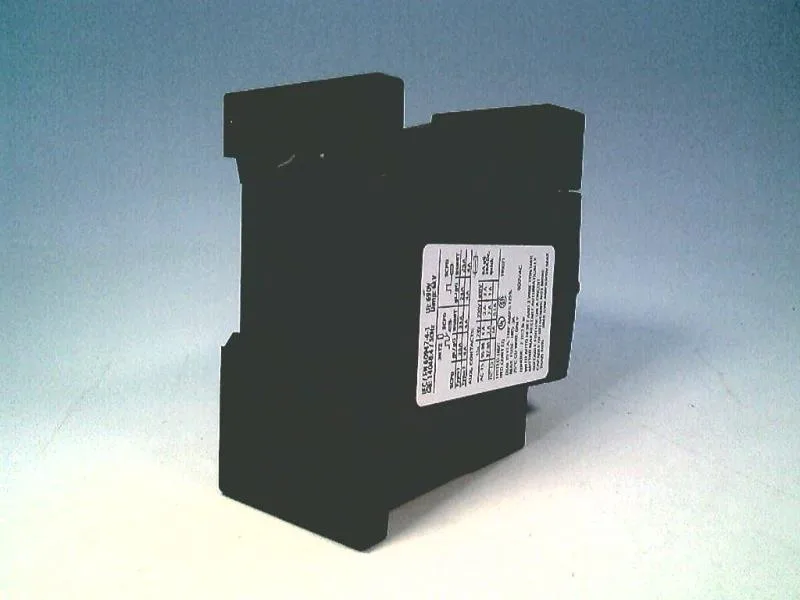
Rated for 690 V, it carries a 2 A continuous current at 24 V and 3 A at 120 V on the auxiliary contacts, which is the signal path that tells the upstream contactor to drop out. The per-pole power dissipation is 1.9 W, so three poles running at full load add about 5.7 W of heat inside the enclosure — factor that into your panel thermal budget if it's a sealed cabinet. The screw-type terminals accept 2× (0.5 to 1.5 mm²) or 2× (0.75 to 2.5 mm²) solid or stranded wire, so you can daisy-chain the motor leads without a separate terminal block.
Integration & Wiring
The S00 frame size — 89 mm high, 45 mm wide, 80 mm deep — fits the standard Siemens contactor footprint for the 3RT2 series. The auxiliary switch is integrated, so there is no separate add-on module to order for the N/C trip-indication contact. The screwdriver tip required is Pozidriv PZ 2 with a shaft diameter of 5 to 6 mm. Temperature compensation is active from -40 to +60 °C, meaning the trip curve stays accurate across that ambient range. The note on the component line reads "for message 'Tripped'" — that is the text the integrated auxiliary contact sends to the PLC or indicator when the relay has operated.
Ratings & Duty
The relay is rated for AC-3e duty up to 690 V, which covers switching of squirrel-cage motors. At 400 V it protects a 0.75 kW motor; at 690 V that rises to 1.1 kW. The auxiliary contact ratings span the common control voltages: 2 A at 24 V, 3 A at 120 V, 2 A at 230 V, 1 A at 400 V, and 0.75 A at 690 V. The 0.3 A at 60 V and 0.22 A at both 110 V and 125 V cover the less common DC or low-voltage AC control circuits. The MTTF with high demand rate is listed at 2 280 years — that figure comes from the IEC 62061 / ISO 13849 reliability calculation for the safety function. It means the probability of dangerous failure per hour is low enough for most machine-guarding applications, though the relay itself is not a safety device; it is a thermal overload relay with a trip-indication contact.