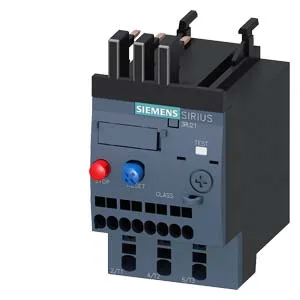
Size S00, so it mates with the 3RT2 contactor range in that frame. The note on the order code ("for message Tripped") means the built-in changeover contact signals a trip condition back to the PLC or annunciator, not just a local flag.
Mounts directly onto the contactor — no DIN rail bracket required for the relay itself, though the contactor may be rail-mounted. The fastening method is contactor mounting, so it clips onto the 3RT2 S00 contactor and makes the power circuit connection through the contactor's main poles. Any mounting position is allowed, which helps in tight enclosures. Accepts 2× (0.5 … 2.5 mm²) solid or stranded copper. The auxiliary circuit uses the same spring-cage style. Keep a 3 mm diameter screwdriver handy for the release slot. Dimensions: 45 mm wide, 87 mm tall, 70 mm deep.
Ratings and ambient conditions
The auxiliary contact ratings cover a wide control-voltage range: 2 A at 24 V AC/DC, 3 A at 120 V, 2 A at 230 V, 1 A at 400 V. At 60 V it's 0.3 A, at 125 V it's 0.22 A, at 220 V it's 0.11 A. That's the switching capacity of the trip-indication contact — enough for a PLC input or a small relay coil. Operating temperature range is -40 … +70 °C, with temperature compensation active over -40 … +60 °C — so the trip curve stays accurate across the normal panel ambient. Storage and transport range is -55 … +80 °C. Power dissipation per pole is 1.9 W at rated current; three poles add up to about 5.7 W inside the enclosure, so factor that into the thermal budget. MTTF with high demand rate is 2,280 years — that's a reliability figure for the safety function, not a service life number. The relay is designed for the motor protection duty cycle, not continuous switching.
Current production — this is an active catalog number, not a phase-out line. The SIRIUS S00 platform is widely stocked and supported. Substance prohibitance date is 10/01/2009, which aligns with the original RoHS directive. No successor has been announced because none is needed.