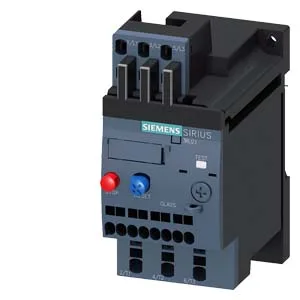
What the Class 10 trip class means for motor protection
The 3RU2116-1BC1: This is the standard trip class for standard-start induction motors driving pumps, fans, and conveyors where the acceleration time stays under 10 seconds. For longer start times (high-inertia loads like centrifuges or crushers), a Class 20 or Class 30 relay would be needed to avoid nuisance tripping during startup. The relay is temperature-compensated from -40 °C to +60 °C, so the trip curve stays consistent across the panel ambient range without manual adjustment.
Size S00 frame and spring-loaded terminals
The 79 mm depth leaves clearance for wiring ducts and adjacent components in a crowded panel. No re-torquing needed after thermal cycling — a maintenance advantage on lines where vibration or temperature swings loosen screw terminals over time.
Auxiliary contact ratings and the tripped signal
An integrated auxiliary switch provides a normally closed (NC) contact that opens when the relay trips, with the note "for message 'Tripped'" — this is the signal you wire back to the PLC or motor control centre to annunciate an overload condition. These ratings define the maximum load the auxiliary contact can switch — stay within them to avoid welding the contacts on an inductive load like a contactor coil.