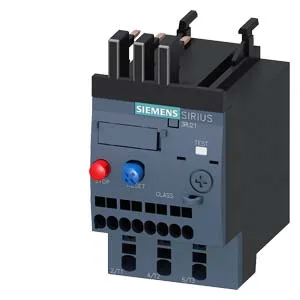
The relay mounts directly onto a contactor (contactor mounting), saving DIN-rail space and keeping the motor branch circuit compact. Rated voltage is 690 V, covering most low-voltage motor applications up to that line-to-line maximum. The operating frequency is 50... 60 Hz, matching standard industrial mains. The integrated auxiliary switch provides a signal contact for the tripped state — the note "for message 'Tripped'" means this contact changes state when the relay operates, so a PLC or indicator can see the fault.
The relay's thermal release is designed for motor protection: the power dissipation per pole is 1.9 W, which matters for thermal coordination inside a sealed enclosure — three poles running at full load add about 5.7 W of heat that needs to be considered in the cabinet thermal design. Auxiliary contact ratings span common control voltages: 2 A at 24 V, 3 A at 120 V, 2 A at 230 V, and 1 A at 400 V. Power ratings at various voltages give a quick motor sizing reference: 0.75 kW at 400 V, 1.1 kW at 500 V, and 1.5 kW at 690 V. At 480 V and 600 V the current rating is 2.5 A. Wire connection uses spring-loaded terminals accepting 2x (0.5... 2.5 mm²) solid or stranded — quick to terminate, no re-torquing needed. A 3 mm diameter screwdriver shaft is specified for the terminal screws.
The temperature compensation range of -40... +60 °C means the trip curve stays accurate even in unheated warehouses or hot machine bays — the relay adjusts for ambient temperature changes automatically. This covers most industrial environments from cold storage to hot manufacturing.
MTTF with high demand rate is 2,280 years. Substance prohibitance date is 10/01/2009, indicating RoHS compliance per the EU directive. The relay carries no special compliance restrictions beyond standard industrial material regulations.