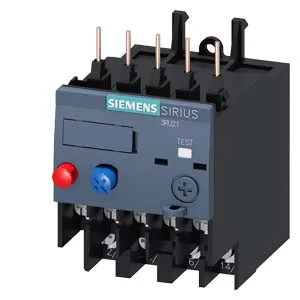
SIRIUS S00 thermal overload relay, Trip Class 10
It mounts directly to a contactor (fastening method: contactor mounting) and can be installed in any position, which simplifies panel layout when space is tight. The relay is rated for a maximum operating voltage of 690 V and handles motor power up to 1.1 kW at 400 V, 1.5 kW at 500 V, and 2.2 kW at 690 V. Its thermal overload release is temperature-compensated across -40 to +60 °C, so the trip curve stays consistent even when the panel ambient drifts.
Switching ratings across the voltage range
The auxiliary contacts on this overload relay are rated for switching at multiple control voltages: 2 A at 24 V, 0.3 A at 60 V, 0.22 A at 110 V, 3 A at 120 V, 0.22 A at 125 V, 0.11 A at 220 V, 2 A at 230 V, and 1 A at 400 V. The 3 A at 120 V rating is the highest continuous current the auxiliary switch can break, so that's the figure to check if your control circuit runs on 120 VAC. For 24 VDC control loops, the 2 A rating is sufficient for most PLC digital inputs and relay coils.
This overload relay is sized S00 and mounts directly to a contactor via the contactor mounting fastening method. Main circuit connections use ring cable lugs (M3 screw for main contacts), and the auxiliary switch is integrated into the relay body. The screwdriver shaft diameter is 5 to 6 mm with a Pozidriv PZ 2 tip, so a common electrician's screwdriver handles the terminals without a special bit.
Environmental and storage ratings
The relay operates across -40 to +70 °C and can be stored or transported from -55 to +80 °C. The operating frequency is 50 to 60 Hz, matching standard line frequencies worldwide. MTTF with high demand rate is 2,280 years, reflecting the solid-state reliability of the bimetallic thermal mechanism.