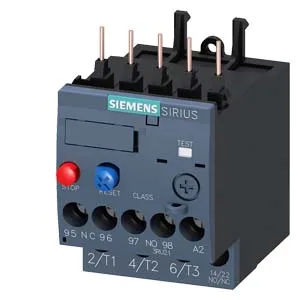
The Siemens 3RU2116-1EB0-ZW96 is a SIRIUS-brand thermal overload relay, size S00, with a trip class of CLASS 10. The relay mounts directly onto a contactor (fastening method: contactor mounting), saving DIN-rail space in the enclosure. The auxiliary switch is integrated and rated for the control circuit: 2 A at 24 V, 3 A at 120 V, 2 A at 230 V, and 1 A at 400 V — covering typical PLC and relay coil loads. The note "for message 'Tripped'" on the listing means this variant includes a dedicated signaling contact that changes state when the relay trips, feeding a status back to the controller or HMI so the line operator sees exactly which motor dropped out.
Motor power ratings are given per voltage: 1.5 kW at 400 V, 2.2 kW at 500 V, and 3 kW at 690 V — these are the AC-3e (squirrel-cage motor switching) values, so the relay is sized for the motor's full-load current, not the contactor's make/break rating. Temperature compensation is active from -40 °C to +60 °C, meaning the trip curve stays accurate even in an unheated enclosure or next to a hot drive. MTTF with high demand rate is 2 280 years — a reliability figure that matters for safety-related applications where the relay is exercised frequently. The screw terminals accept 2×(0.5…1.5 mm²) or 2×(0.75…2.5 mm²) solid or stranded wire, with a Pozidriv PZ 2 screwdriver tip and a 5–6 mm shaft diameter.
The part carries a substance prohibition date of 10/01/2009.
Mounts directly onto a SIRIUS contactor of size S00 — no DIN-rail bracket needed. The main circuit connections are screw-type terminals; the auxiliary contact is integrated, so no separate add-on block is required for the trip signal.