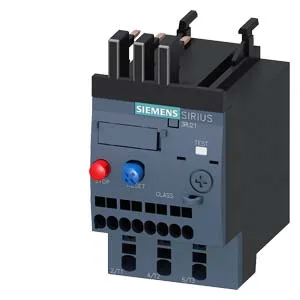
The Siemens 3RU2116-1EC0 is a SIRIUS thermal overload relay in the S00 frame size, designed for direct contactor mounting — it snaps onto the matching 3RT2 contactor without extra wiring brackets. The auxiliary contact block is integrated, not a bolt-on add-on, saving one DIN rail position. Rated insulation voltage is 690 V, and the relay carries motor power ratings of 1.5 kW at 400 V, 2.2 kW at 500 V, and 3 kW at 690 V — these are the AC-3e values that govern motor protection selection, not the thermal current alone. Temperature compensation is active from -40 to +60 °C, so the trip curve stays accurate across the panel ambient range without manual adjustment.
Auxiliary contact ratings — what the voltage columns mean for your control circuit
The integrated auxiliary switch is rated at different currents depending on the control voltage you are switching: 3 A at 120 V AC, 2 A at 24 V DC and at 230 V AC, 1 A at 400 V AC, and 0.75 A at 690 V AC. These are the make/break capacities for the signal contact feeding the PLC input or the holding circuit on the contactor coil. If your control voltage is 24 V DC, the 2 A rating covers most small PLC input modules and contactor coils in the S00 range — no interposing relay needed for a single load.
Dimensions are 45 mm wide, 87 mm tall, 70 mm deep — the S00 footprint that mates directly with the 3RT2 contactor. The main circuit uses spring-loaded terminals accepting 2 × (0.5 to 2.5 mm²) solid or stranded copper. Screwdriver slot is 3.0 × 0.5 mm, so a standard 3 mm flat-blade fits. Mounting position is any, which helps when the contactor is oriented sideways in a tight gland-plate layout.
The relay includes temperature compensation across the operating range, so the trip characteristic does not drift with panel heat. Substance prohibition date is 10/01/2009, indicating RoHS compliance from that date forward.