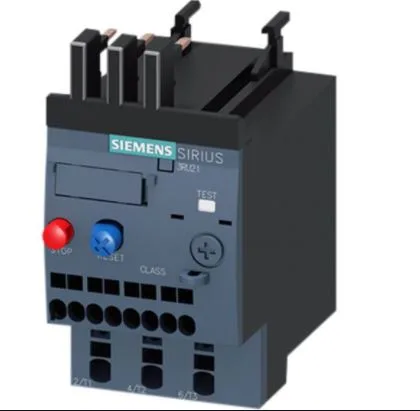
CLASS 10 trip curve and what it means on the line
The 3RU2116-1FC0: That's the standard for standard-duty motor starting; if your motor has a long acceleration time (high-inertia loads like centrifuges or large fans), CLASS 10 may trip during start, and you'd need a CLASS 20 or CLASS 30 relay instead. Rated for main circuits up to 690 V, it mounts directly onto the contactor (size S00 frame) — no DIN-rail bracket needed, which saves panel width.
Auxiliary contact ratings — what they actually switch
These are the make/break limits for the signal circuit — don't plan to switch a contactor coil directly at 690 V through this contact; it's sized for PLC inputs or indicator lamps. Power dissipation per pole is 2.2 W — three poles running at full load current add 6.6 W of heat inside the enclosure. In a sealed panel with multiple relays, that heat builds up and can shift the trip curve if ambient exceeds 40 °C.
Mounting and wiring — the gotchas
Fastening method is contactor mounting — the relay clips onto the contactor's S00 frame. No DIN-rail adapter needed, but the contactor itself must be DIN-rail or screw-mounted. Mounting position is any, so vertical or horizontal orientation is fine. Use a screwdriver with a 3 mm diameter shaft and 3.0 × 0.5 mm tip to actuate the spring release. The auxiliary terminals are also spring-loaded — same wire range.
Environmental limits and temperature compensation
The relay includes temperature compensation from -40 to +60 °C, meaning the trip curve stays accurate across that band without manual adjustment — important for outdoor or unheated enclosures. Substance prohibitance date is 10/01/2009 — the relay complies with RoHS and REACH requirements as of that date.