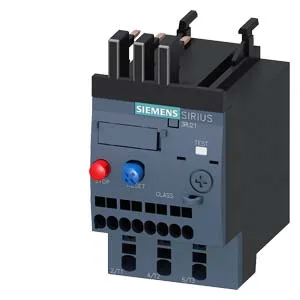
It protects motors against overload and phase failure by monitoring current draw through a bimetallic strip that actuates a trip mechanism. The auxiliary contact set is integrated — no add-on block needed — and carries ratings from 2 A at 24 V up to 3 A at 120 V and 1 A at 400 V, covering most PLC and contactor coil circuits.
This relay mounts directly onto a contactor — no DIN rail required. The fastening method is contactor mounting, which means it clips onto the front of a matching SIRIUS contactor and connects electrically through the main power terminals. The main current circuit uses M3 ring cable lugs, so expect to terminate with ring terminals rather than ferrules or bare wire. Temperature compensation is active from -40 °C to +60 °C, so the trip curve stays accurate even in unheated plant environments.
The auxiliary contact current ratings are given at specific voltages — 2 A at 24 V, 3 A at 120 V, 1 A at 400 V, and so on. These are the make/break capacities for the signal contacts, not the main power path. If you're switching a 24 VDC PLC input, the 2 A rating is more than adequate; at 400 VAC for a contactor coil, the 1 A rating handles it. The note "for message 'Tripped'" on the spec line refers to the auxiliary contact configuration that signals a trip condition to a PLC or HMI. This is a normally-closed or changeover contact that opens when the relay trips, giving a positive indication rather than relying on current sensing.