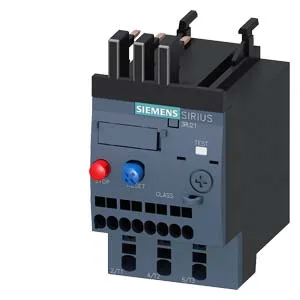
The relay is rated for a maximum operational voltage of 690 V, with an AC-3e rated value maximum of 690 V — this is the voltage class for standard three-phase motor circuits up to 690 V line-to-line. The motor power ratings are given at several common voltages: 3 kW at 400 V, 4 kW at 500 V, and 5.5 kW at 690 V. At 480 V and 600 V, the current rating is 8 A. These are the values you use for BOM matching: if your motor is 3 kW on a 400 V supply, this relay is correctly sized. The auxiliary switch is integrated and carries a note "for message 'Tripped'" — meaning the built-in auxiliary contact signals the tripped state, not just the normal/overload status. This is useful for PLC or HMI annunciation of a thermal trip without needing a separate auxiliary block. The switching capacity varies by voltage: 2 A at 24 V, 3 A at 120 V, 2 A at 230 V, 1 A at 400 V, and 0.75 A at 690 V. These are the maximums for the auxiliary contact; stay within them for reliable signalling. The relay has temperature compensation from -40 to +60 °C, meaning the trip curve stays accurate across that ambient range — important for panels in unconditioned spaces or near process heat. The MTTF with high demand rate is 2,280 years, which supports use in safety-related applications where reliability data is required for SIL calculations.
It mounts directly to a contactor (contactor mounting) in any position. The spring-loaded terminals accept 2 × (0.5 to 2.5 mm²) solid or stranded wire. For the auxiliary screw terminals, use a screwdriver with a 3 mm diameter shaft and a 3.0 × 0.5 mm tip. No DIN rail adapter is required if mating to a contactor; if used standalone, a separate mounting base is needed.