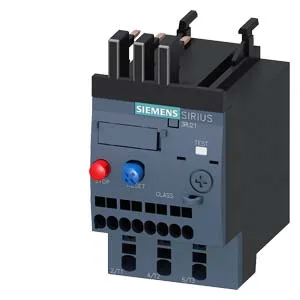
It mounts directly to a SIRIUS contactor (contactor mounting), saving DIN-rail space and keeping the motor branch compact. The integrated auxiliary switch provides a 'Tripped' signal — the Note for message confirms this relay reports its status through that auxiliary contact, so a PLC or indicator can see the fault without extra wiring. The thermal bimetallic release tracks motor heating accurately, and temperature compensation from -40 to +60 °C keeps the trip curve stable across the panel environment.
Rated insulation voltage is 690 V, and the AC-3e switching maximum is also 690 V — this relay is suitable for 400 V and 480 V motor circuits common in European and North American panels. Motor power ratings are 3 kW at 400 V, 4 kW at 500 V, and 5.5 kW at 690 V, so it covers small to medium motor loads in the S00 frame. The auxiliary contact ratings span multiple control voltages: 2 A at 24 V DC, 3 A at 120 V AC, 2 A at 230 V AC, and 1 A at 400 V AC. That covers most PLC input and relay coil loads without an interposing relay. The spring-loaded terminals on the main circuit accept 2x (0.5 to 2.5 mm²) solid or stranded wire — no screw torque to verify, just strip and push. Dimensions are 45 mm wide, 87 mm high, 70 mm deep — the S00 footprint fits standard 45 mm-wide contactor slots.
The substance prohibitance date of 10/01/2009 aligns with early RoHS compliance — the relay meets EU RoHS requirements for the materials restriction. No UL or CSA mark is listed in the evidence, so verify local code acceptance if those marks are required for your jurisdiction.
This relay snaps onto a SIRIUS contactor (e.g., 3RT2 series) without extra wiring between the contactor and the overload — the power connections pass through the relay. The auxiliary contact is integrated, so no add-on block is needed for the trip signal. The MTTF of 2 280 years at high demand rate reflects the electromechanical reliability for a relay that sees infrequent operation — it's the thermal trip that does the work, not the contacts.