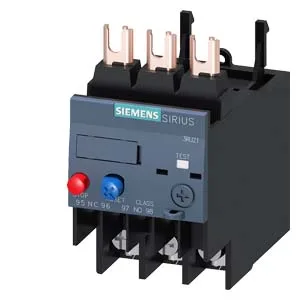
Rated for 690 V and 50-60 Hz operation, it mounts directly onto a contactor (fastening method: contactor mounting), saving panel space versus a standalone enclosure. The thermal release design compensates for ambient temperature between -40 and +60 °C, so the trip point stays accurate across the enclosure's internal heat rise. Motor power ratings it can protect: 1.5 kW at 400 V, 2.2 kW at 500 V, and 4 kW at 690 V. The auxiliary switch is integrated — no add-on block needed for the trip-indication signal.
Size S0 means it fits the standard S0 contactor footprint — direct snap-on or screw-clamp mounting to the contactor, no additional DIN-rail bracket needed. The ring-cable-lug connection for the main circuit handles M4 ring terminals. Mounting position is any, so horizontal or vertical panel layouts work without derating the trip curve. Dimensions: 45 mm wide × 85 mm high × 85 mm deep — fits within a standard 45 mm module slot. The auxiliary switch uses a Pozidriv PZ2 screwdriver tip with a 5-6 mm shaft diameter.
Auxiliary contact ratings and the 'Tripped' message
The integrated auxiliary switch carries the trip-indication signal. Its contact ratings vary by voltage: 2 A at 24 V AC, 3 A at 120 V AC, 2 A at 230 V AC, 1 A at 400 V AC, and 0.22 A at 125 V DC. The Note for message 'Tripped' on the component line refers to the state when the relay has operated — the auxiliary contact changes state to signal a trip condition to the PLC or annunciator.
Operating temperature range: -40 to +70 °C. Storage and transport: -55 to +80 °C. Temperature compensation active from -40 to +60 °C. The substance prohibition date of 10/01/2009 aligns with RoHS compliance (lead-free and other restricted substances). MTTF with high demand rate: 2,280 years.