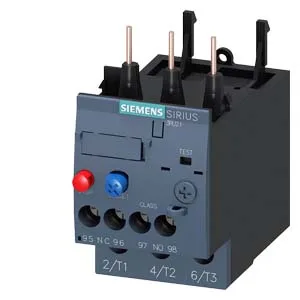
Rated at 690 V, with a maximum AC-3e switching voltage of 690 V, it covers 400 V, 480 V, 500 V, 600 V, and 690 V line supplies — the power ratings at those voltages are 5.5 kW, 12.5 A, 7.5 kW, 12.5 A, and 7.5 kW respectively.
The auxiliary contact ratings tell you what the integrated switch can handle: 2 A at 24 V, 3 A at 120 V, 2 A at 230 V, and 1 A at 400 V — these are the make/break capacities for the signal circuit feeding the PLC input or contactor coil. At 60 V the auxiliary contact is rated 0.3 A, at 110 V it is 0.22 A, at 125 V it is 0.22 A, and at 220 V it is 0.11 A — these lower DC ratings reflect the arc-extinction limits of the same switch when switching DC loads. The thermal overload release is temperature-compensated from -40 °C to +60 °C, so the trip curve stays accurate across most panel ambient conditions without manual adjustment. Power dissipation per pole is 2.2 W — useful for calculating the heat load inside a sealed enclosure when the relay is carrying full current.
Fastens directly to a contactor via the contactor mounting method — no DIN-rail adapter needed, though the S0 frame can also be snapped onto a DIN rail if the contactor itself is rail-mounted. Main circuit connections are screw-type terminals accepting 2x (0.5 to 1.5 mm²) or 2x (0.75 to 2.5 mm²) solid or stranded wire; the screwdriver tip required is Pozidriv PZ 2 with a shaft diameter of 5 to 6 mm. Dimensions are 85 mm deep, 45 mm wide, and 85 mm high — the S0 footprint is compact enough for high-density panels.
Substance prohibitance date is 10/01/2009, which aligns with the original RoHS compliance deadline — the relay meets RoHS requirements. MTTF with high demand rate is 2 280 years — a reliability figure that reflects the thermal bimetal design's long service life in cycling applications.