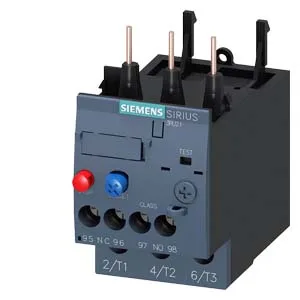
The relay mounts directly onto a contactor (fastening method: contactor mounting), so it shares the same DIN-rail or screw-panel footprint as the contactor it pairs with, keeping the panel layout compact.
The integrated auxiliary switch provides a signal output — a 'Tripped' message — that can be wired into the PLC or annunciator. Its contact ratings vary by voltage: 2 A at 24 V, 3 A at 120 V, 2 A at 230 V, and 1 A at 400 V. These are the maximum continuous currents the auxiliary contacts can switch at those voltages; for DC applications the ratings drop significantly (0.3 A at 60 V, 0.22 A at 110 V, 0.11 A at 220 V). The auxiliary switch is designed as an integrated part of the relay — no separate add-on module needed — which simplifies ordering and panel wiring.
Environmental and mounting details
The relay is temperature-compensated over -40 to +60 °C, so the trip curve stays accurate across the typical panel ambient range. Dimensions are 85 mm depth, 45 mm width, 85 mm height — the S0 footprint common to this Siemens series. Screw terminals accept 2× (0.5 to 1.5 mm²) or 2× (0.75 to 2.5 mm²) solid or stranded wire, with a Pozidriv PZ2 screwdriver tip. The substance prohibitance date of 10/01/2009 indicates RoHS compliance per the EU directive.