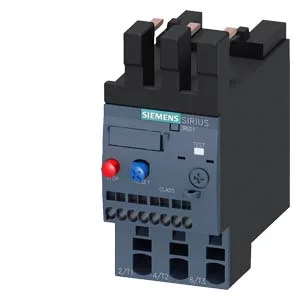
It's the overcurrent protection element you mount directly onto a contactor — the part that watches motor current and trips when the load stays high too long. The integrated auxiliary switch signals the tripped state back to the PLC or annunciator.
Trip Class and What It Decides
That's the standard for standard-duty motor starting — pumps, fans, compressors that accelerate unloaded. If you're protecting a high-inertia load (centrifuge, flywheel) that needs a longer acceleration ramp, CLASS 10 is too fast; you'd want CLASS 20 or 30. For most general-purpose three-phase motors on 50/60 Hz supply, CLASS 10 is the correct call.
S0 frame size, 45 mm wide, 102 mm tall, 84 mm deep. Fastens directly to the contactor — no DIN rail required, no extra bracketry. Spring-loaded terminals on the main circuit accept 2x (0.5... 2.5 mm²) solid or stranded. The screwdriver tip needed is 3.0 x 0.5 mm, shaft diameter 3 mm — keep that driver in the panel kit.
Environmental Reach
That's a part that survives the ride in an unheated truck and still works when you power it up at site.
Current production.