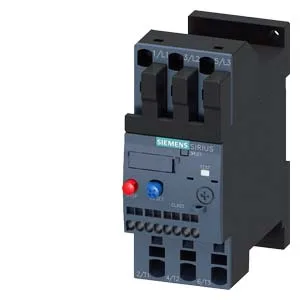
What this relay does and how it fits
It uses a thermal bimetallic release and integrates the auxiliary switch directly into the housing. Rated at 690 V with a maximum AC-3e switching voltage of 690 V, it handles motor circuits up to 7.5 kW at 400 V, 11 kW at 500 V, and 15 kW at 690 V. The auxiliary contact ratings span the control-voltage range you are likely to find in a panel: 2 A at 24 V, 3 A at 120 V, 2 A at 230 V, 1 A at 400 V, and 0.75 A at 690 V. That covers most PLC output cards and contactor coils without a separate interposing relay. The size S0 is the most common frame for motor starters up to about 15 kW; it mates with the corresponding S0 contactor (3RT10 series) without adapters. Spring-loaded terminals accept 2 × (0.5 to 2.5 mm²) solid or stranded wire, which speeds up wiring compared to screw terminals and holds better under vibration.
The physical dimensions — 114 mm height, 45 mm width, 95 mm depth — fit the standard S0 slot. If you are replacing a failed relay in an existing panel, measure the depth clearance: 95 mm is shallower than some older European designs, so it should drop in without hitting the backplane or gland plate. The spring-loaded terminals require a screwdriver with a 3 mm shaft diameter and a 3.0 × 0.5 mm tip — a standard slotted driver, nothing special. Temperature compensation is active from -40 to +60 °C. The MTTF under high-demand operation is 2,280 years.
The relay carries a substance prohibition date of 10/01/2009, which aligns with the original RoHS directive (RoHS 1). Current production complies with RoHS 2/3 and REACH. The SIRIUS family is designed to IEC 60947-4-1 and carries UL/CSA approvals for the North American market. A full declaration of conformity and the technical datasheet are available from Siemens Industry Online Support.