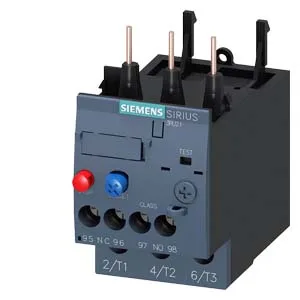
The relay is sized as S0, the compact frame in the SIRIUS family, designed to mount directly onto the matching S0 contactor (e.g. 3RT20xx) via the contactor mounting fastening method — no separate base or DIN-rail adapter needed.
The relay carries motor power ratings at several common line voltages: 11 kW at 400 V, 11 kW at 500 V, and 18.5 kW at 690 V. At 480 V and 600 V the listed current ratings are 22 A each. These are the AC-3e rated values — the duty cycle for starting and running a standard induction motor. If your BOM specifies a 22 A motor at 480 V, this relay covers it. Auxiliary contact ratings are given across multiple control voltages: 2 A at 24 V and 230 V, 3 A at 120 V, 1 A at 400 V, and lower values for 60 V, 110 V, 125 V, and 220 V. These are the switching capacities for the integrated auxiliary switch — the signal that tells the PLC "motor tripped." The note "for message 'Tripped'" on the order code confirms this variant includes a dedicated signaling contact for that status. Thermal power dissipation per pole is 2.7 W. In a densely packed panel with multiple relays, that heat adds up — factor it into your enclosure thermal budget, especially if the ambient inside the cabinet approaches the 70 °C operating limit.
Mounts directly onto the S0 contactor — no separate DIN-rail footprint, no extra wiring between contactor and relay. The fastening method is "contactor mounting": the relay clips onto the contactor's body and the main power connections pass through. Screw-type terminals on the main current circuit accept 2×(0.5…1.5 mm²) or 2×(0.75…2.5 mm²) solid or stranded wire. The screwdriver spec is Pozidriv PZ2, shaft diameter 5–6 mm. Temperature compensation is active from -40 °C to +60 °C, meaning the trip curve stays accurate across that ambient range.
The substance prohibitance date of 10/01/2009 indicates RoHS compliance to the original EU directive. As a current-production Siemens industrial component, it also carries the expected CE, UL, and CSA approvals (typical for the SIRIUS family), though specific cert numbers are not listed in this spec excerpt. For a pharmaceutical GMP application, the documentation package (declaration of conformity, material certificates) should be obtainable from Siemens support.