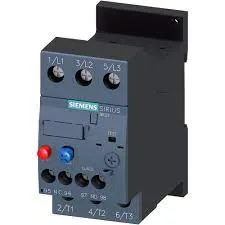
The Siemens SIRIUS 3RU2126-4DB1 is a thermal overload relay — the part that sits between the contactor and the motor, watching current and tripping before the winding cooks. The relay is size S0, the most common frame in the SIRIUS modular system, and it mounts stand-alone or directly onto a matching SIRIUS contactor.
At 400 V AC-3e duty it's rated for 11 kW motor output; at 690 V that rises to 22 kW. The current setting range is covered by the 25 A rating at 480 V and 600 V. These are the numbers that decide whether this relay matches your motor nameplate — if your motor FLA sits inside the adjustment range of this unit, it's the right pick. Trip Class 10 is the default for most general-purpose motor starting. If you're starting a high-inertia load (centrifuge, flywheel) that needs a longer acceleration ramp, you'd want Class 20 or 30 — but for conveyors, pumps, compressors, and fans, Class 10 is correct and gives faster protection against a stalled rotor.
Dimensions are 45 mm wide, 97 mm tall, 95 mm deep — a compact S0 footprint that fits a standard 45 mm-wide DIN-rail slot. Mounting position is any, which helps when panel space is tight. The main circuit terminals accept screw-type connections: 2× (0.5 to 1.5 mm²) or 2× (0.75 to 2.5 mm²) solid or stranded. Use a PZ2 Pozidriv screwdriver with a 5–6 mm shaft diameter. Temperature compensation is active from -40 to +60 °C, so the trip curve stays accurate in a warm cabinet.
The part is RoHS-compliant per the substance prohibition date of October 1, 2009. The MTTF with high demand rate is listed at 2,280 years — a reliability figure that supports holding this as a critical spare without worrying about shelf-life degradation. The note on the product line reads "for message 'Tripped'" — this is the signal the integrated auxiliary switch sends when the relay has operated, used to trigger an alarm or stop the contactor.