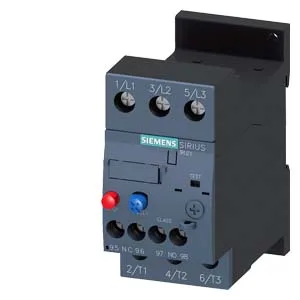
The relay is rated for 18.5 kW at 400 V, and can handle up to 690 V rated insulation voltage. It uses screw-type terminals for the main current circuit, sized for M4 screws, and accepts 2x (0.5 to 1.5 mm²) or 2x (0.75 to 2.5 mm²) solid or stranded wire. The auxiliary switch is integrated, with a note for message "Tripped" — that's the NC contact that changes state when the bimetals warp, giving you a remote trip indication.
Class 10 is the key selection parameter here. It's designed to coordinate with contactors and circuit breakers in a motor starter assembly — the overload relay handles the thermal protection, not the short-circuit interruption. The 18.5 kW rating at 400 V is for AC-3e duty (squirrel-cage motors: starting, switching off during running). At 480 V it's rated for 40 A, and at 690 V for 37 kW. The temperature compensation range of -40 to +60 °C means the bimetal curve stays accurate even if the panel ambient drifts — critical when the relay sits next to a hot contactor.
That means you need to plan for DIN rail or direct panel mounting, and wire it separately from the contactor. The size S0 frame is compact: 45 mm wide, 97 mm high, 95 mm deep. For the auxiliary contacts, the screw terminals use a Pozidriv PZ 2 tip, with a screwdriver shaft diameter of 5 to 6 mm. The MTTF with high demand rate is listed at 2,280 years — a reliability figure for safety-related applications, though this is a standard thermal relay, not a safety-rated device.