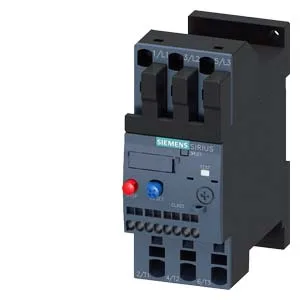
It protects motors against overcurrent by monitoring the phase current and tripping a built-in auxiliary contact when the thermal model reaches the threshold. It is temperature-compensated from -40 to +60 °C, so the trip curve stays accurate across the panel's ambient range. The auxiliary switch is integrated — no add-on module needed for the tripped signal. The note "for message "Tripped"" on the spec line refers to the auxiliary contact state that signals an overload condition back to the PLC or annunciator. That contact is what the controls integrator wires to the digital input for the motor-fault summary.
The S0 footprint is 45 mm wide × 114 mm high × 95 mm deep, so it fits a standard 45 mm slot in a motor-starter row. Spring-loaded terminals on the main circuit accept 2× (0.5...2.5 mm²) solid or stranded copper — no screw torque to verify, just strip and push. The auxiliary contact ratings cover most control voltages: 2 A at 24 V, 3 A at 120 V, 2 A at 230 V, 1 A at 400 V. At 60 V it's 0.3 A; at 110 V and 125 V it's 0.22 A; at 220 V it's 0.11 A. Power dissipation per pole is 3.2 W — factor that into the enclosure thermal budget if you're packing several relays side by side.
The substance prohibitance date of 10/01/2009 aligns with the original EU RoHS compliance deadline. The relay is compliant with RoHS and REACH as a standard SIRIUS product. No special documentation beyond the standard declaration is required for most industrial panels.