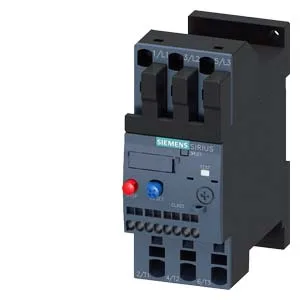
The relay is rated for 15 kW at 400 V and 22 kW at 690 V (AC-3e duty), with a maximum rated insulation voltage of 690 V.
The Trip Class 10 rating governs the thermal curve: it allows the motor to draw starting current for up to 10 seconds before the bimetallic strip trips. That suits motors that reach full speed within that window — standard squirrel-cage induction motors on centrifugal loads. For high-inertia loads (crushers, centrifuges) that need a longer acceleration ramp, a Class 20 or Class 30 relay would be required; this one will nuisance-trip on those. The power ratings are tied to specific voltages: 15 kW at 400 V, 18.5 kW at 500 V, and 22 kW at 690 V. The current ratings at 480 V and 600 V are both 28 A, which gives you the thermal setting range. The relay's rated insulation voltage is 690 V, so it can be used on 400 V, 480 V, 600 V, and 690 V systems without derating the insulation. The auxiliary switch is integrated — no separate add-on block needed. The switch ratings cover a wide control-voltage range: 2 A at 24 V, 3 A at 120 V, 2 A at 230 V, and 1 A at 400 V, among others. That means the same relay works in 24 VDC control circuits and 230 VAC panels without swapping the auxiliary contact block. Termination is spring-loaded (cage-clamp style), accepting 2× 0.5 to 2.5 mm² solid or stranded. No screw torque to verify — just strip to 8 mm and push in. The relay mounts in any position and is designed for stand-alone installation, not ganged to a contactor.
The relay carries a substance prohibition date of October 1, 2009, aligning with RoHS and REACH substance restrictions. Temperature compensation is active from -40 to +60 °C, so the thermal curve stays accurate across the typical industrial panel ambient.