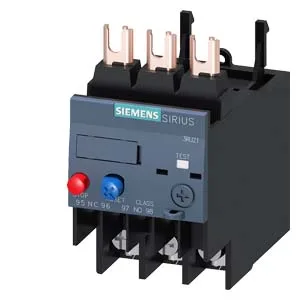
Rated at 690 V and sized for the S0 frame, this relay mounts directly onto a contactor of the same frame, keeping the panel wiring compact. The thermal release is temperature-compensated from -40 to +60 °C, so the trip point stays consistent whether the panel sits in a cold warehouse or a warm machine room.
The headline power rating is 18.5 kW at 400 V, which tells you the motor it can protect in a standard 400 V three-phase system — match this to your motor nameplate, not the contactor rating. At 480 V it carries 36 A; at 600 V the same 36 A, and at 690 V it handles 30 kW — the current limit is the same across the higher voltages, so the relay's thermal element is current-limited, not voltage-limited, above 480 V. The auxiliary switch is integrated — one normally-open and one normally-closed contact, rated at 2 A at 24 V, 3 A at 120 V, 2 A at 230 V, and 1 A at 400 V. That covers the feedback signal to the PLC or the trip indication lamp without an add-on block. The note "for message 'Tripped'" on the product line means the auxiliary contacts change state when the bimetals have reached the trip threshold — this is the signal you wire back to the control system to flag an overload condition.
Fastens directly onto the contactor — no DIN rail needed, which saves a slot in the panel. Mounting position is any orientation, so it fits in tight enclosures or vertical bus stacks. Main circuit connection is via ring cable lugs, M4 screws. The auxiliary wiring uses screw terminals; the screwdriver shaft should be 5 to 6 mm diameter with a Pozidriv PZ2 tip.
MTTF at high demand rate is 2,280 years. Because it is active and standard, lead time is typically the factory lead for the SIRIUS line — no broker or surplus premium involved.