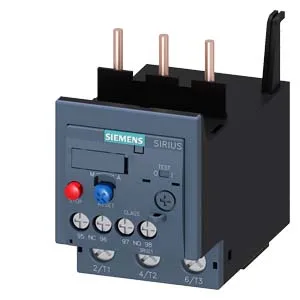
The Siemens 3RU2136-1JB0 is a SIRIUS S2 thermal overload relay, Trip Class 10, designed to protect AC motors against overload and phase failure by monitoring motor current through a bimetallic thermal element. It mounts directly to the matching SIRIUS contactor (contactor mounting,) and connects to the main circuit via screw-type terminals. The integrated auxiliary switch provides a signal contact for the tripped state — the part carries a note "for message Tripped", meaning its auxiliary contact is wired to report an overload trip back to the PLC or annunciator. Rated insulation voltage is 690 V, and the relay is rated for motor power up to 4 kW at 400 V, 5.5 kW at 500 V, and 7.5 kW at 690 V. The AC-3e maximum operating voltage is also 690 V. These ratings mean the relay is sized for IEC motor circuits up to that power band — typical for pump, fan, and conveyor drives in the 4–7.5 kW range on 400 V three-phase networks.
Auxiliary contact ratings — what the signal side can handle
The integrated auxiliary switch is rated for switching at several common control voltages: 2 A at 24 V, 3 A at 120 V, 2 A at 230 V, 1 A at 400 V, and 0.75 A at 690 V. Lower ratings apply at 60 V (0.3 A,), 110 V (0.22 A,), 125 V (0.22 A,), and 220 V (0.11 A,). These are the maximum continuous currents the auxiliary contact can make and break — useful when sizing the PLC input or relay coil that the trip signal drives.
Mounting and wiring — panel integration
The relay mounts directly to the SIRIUS contactor — no separate DIN-rail footprint, saving panel space. Dimensions are 55 mm wide, 90 mm high, and 105 mm deep. The main circuit terminals accept 2x (0.5…1.5 mm²) or 2x (0.75…2.5 mm²) solid or stranded wire, with screw terminals requiring a Pozidriv PZ 2 tip and a screwdriver shaft diameter of 5…6 mm. The auxiliary switch is integrated, so no separate add-on block is needed for the trip signal.
Temperature compensation is active from -40…+60 °C, ensuring the trip curve stays accurate across the working range. The relay carries a substance prohibitance date of 09/08/2017, indicating RoHS/REACH compliance for that cutoff.