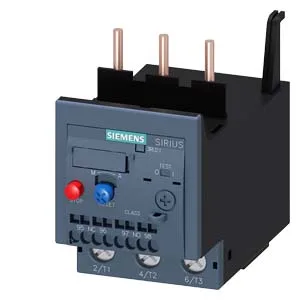
The thermal bimetallic element tracks the motor's heating curve, so the relay follows the actual load rather than a fixed threshold. Rated insulation voltage is 690 V, with a 5.5 kW motor rating at 400 V AC-3e duty (the standard for squirrel-cage motors). The auxiliary switch is integrated — no separate add-on block needed for the trip indication or a remote reset circuit. The "for message 'Tripped'" note on the nameplate is a visual indicator that the relay has operated. When the bimetallic strip deflects, it pushes a mechanical flag — you see the word "Tripped" through a window on the front face. No need to meter the contacts; one glance tells you the starter needs a reset.
Mounting and wiring in the panel
Fastening method is contactor mounting — the relay clips directly onto the output side of a SIRIUS S2 contactor. This keeps the power wiring short and the assembly footprint tight. Main circuit terminals are screw-type, accepting 2 × (0.5 to 2.5 mm²) solid or stranded wire. The screwdriver spec is Pozidriv PZ2 with a 5–6 mm shaft diameter. Depth is 105 mm, width 55 mm, height 90 mm — fits a standard S2 starter slot. Temperature compensation is active from -40 °C to +60 °C, so the trip curve stays accurate even if the panel warms up near the motor.
Substance prohibitance date is 10/15/2014, which aligns with the EU RoHS compliance timeline. The relay carries the usual Siemens documentation package — RoHS, REACH, and the IEC 60947-4-1 standard for electromechanical contactors and motor-starters.
The 3RU2116-1FC1 is the smaller S0-frame sibling in the same SIRIUS family. The 3RU2136-1KD0 (Size S2) handles higher motor currents — up to 5.5 kW at 400 V versus the S0 frame's lower power range. Both share Trip Class 10, the same contactor-mounting philosophy, and the integrated auxiliary switch. The physical footprint is larger on the S2, so it will not drop into a panel wired for an S0 starter without re-drilling the mounting holes and re-terminating the power cables.