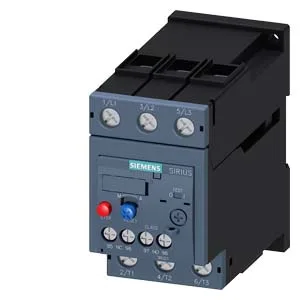
It's the S2 frame size, the middle of the SIRIUS overload relay range, sized for contactors in the 32 A to 40 A motor-full-load-current band. The thermal bimetal release is temperature-compensated across -40 to +60 °C, so ambient swings in an unheated enclosure don't drift the trip point.
Mounts in any position — stand-alone installation on a panel or directly onto the matching SIRIUS contactor. The main circuit terminals are screw-type, accepting 2× (0.5 to 1.5 mm²) or 2× (0.75 to 2.5 mm²) solid or stranded copper. Use a Pozidriv PZ2 bit with a 5–6 mm shaft diameter. The auxiliary switch is integrated into the housing — no add-on block needed for the trip/alarm signal. Dimensions: 105 mm high, 55 mm wide, 117 mm deep. That depth is the body only — allow extra for terminal screw clearance and wiring bend radius when laying out the panel.
The auxiliary contacts are rated across a wide voltage range, and the current capability drops as voltage rises — that's typical for a thermal relay's signal contacts. At 24 V it switches 2 A; at 230 V it still handles 2 A; at 400 V it's 1 A; at 690 V it's 0.75 A. The 120 V rating is 3 A, the highest on the table. These numbers govern what the trip/alarm contact can drive — a PLC input, a pilot light, or an annunciator — without welding the contacts. The main contactor coil draw is not switched by this relay — the overload relay's contacts are the signal path, not the power path. The per-pole power dissipation is 4.6 W, which matters for thermal rise inside a crowded enclosure.
That covers most indoor and outdoor cabinet environments short of direct steam or cryogenic service.