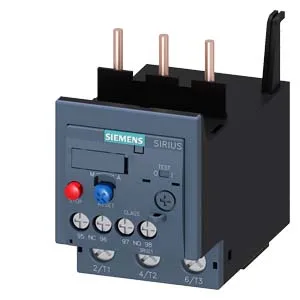
It's the part that sits between your contactor and motor, watching current draw and tripping on overload before the winding insulation gives up. The "ZX95" suffix flags a special version with a "Tripped" message indication — meaning the relay's auxiliary contacts signal a trip state rather than just a reset state, which matters for PLC or HMI feedback on a line. The thermal bimetal design compensates for ambient temperature from -40 to +60 °C, so it doesn't drift on a hot summer day in an unventilated panel.
Mounts directly onto the contactor via the "contactor mounting" fastening method — no DIN rail bracket needed, no extra wiring between the two. Sits in any position, which helps when you're cramming gear into a tight enclosure. Main circuit connections are screw-type terminals, accepting 2x (0.5 to 1.5 mm²) or 2x (0.75 to 2.5 mm²) solid or stranded. Dimensions are 55 mm wide, 90 mm high, 105 mm deep — fits the standard S2 footprint. The M6 main contact screws and Pozidriv PZ2 terminal screws are what you'd expect on this frame size.
The relay is rated for motor duty up to 22 kW at 400 V, 30 kW at 500 V, and 45 kW at 690 V — those are the AC-3e (squirrel-cage motor starting) values. At 480 V and 600 V, the maximum continuous current is 50 A. The auxiliary contacts handle 2 A at 24 V, 3 A at 120 V, and 1 A at 400 V — enough to drive a PLC input or a small indicator lamp, but not a contactor coil directly. Per-pole power dissipation is 5.2 W. In a multi-motor panel with several relays, that heat adds up — factor it into your enclosure thermal calculation, especially if the panel is sealed.
Substance prohibitance date is October 15, 2014. No UL or CSA marks are listed in the spec record.