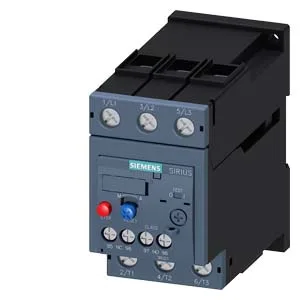
It mounts directly to a contactor or stands alone, and its thermal bimetallic release tracks motor heating with temperature compensation from -40 to +60 °C — meaning the trip point stays stable whether the panel is in a cold warehouse or a hot NEMA enclosure next to a furnace. Rated insulation voltage is 690 V, and the relay is rated for motor loads up to 30 kW at 400 V (AC-3e duty), 37 kW at 500 V, and 55 kW at 690 V. The 57 A current rating at 480 V and 600 V confirms its place in North American 480 V systems as well as IEC 400 V installations.
The integrated auxiliary switch (1 N/O + 1 N/C, flagged by the 'Tripped' message) carries 2 A at 24 V, 3 A at 120 V, 2 A at 230 V, 1 A at 400 V, and 0.75 A at 690 V. The 24 V 2 A rating is the one most PLC input cards will see — it comfortably drives a 24 VDC relay or a digital input module, provided the total loop draw stays under that figure. At 120 VAC the 3 A rating handles a typical motor-starter pilot light or alarm annunciator. The 0.75 A at 690 V is for the rare case where the auxiliary feeds a 690 V control transformer; most panels never see that.
Dimensions are 55 mm wide, 105 mm tall, 117 mm deep — the S2 footprint. It mounts in any position, stand-alone or ganged to a SIRIUS contactor. Main circuit terminals accept 2 x (0.5 to 1.5 mm²) or 2 x (0.75 to 2.5 mm²) solid or stranded copper, terminated with a Pozidriv PZ2 screwdriver (shaft diameter 5 to 6 mm). The M6 screw on the main contacts is common for this frame size; torque it to the manufacturer's spec, not by feel.