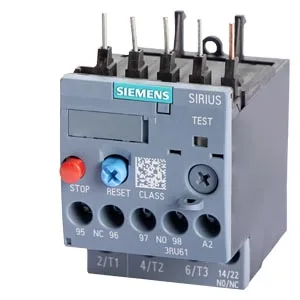
It mounts directly onto the matching S00 contactor — no DIN rail bracket needed, just snap it on the contactor's front face. The adjustable current response range is 0.45 to 0.63 A, set by a dial on the front. Trip class is Class 10, meaning it will trip within 10 seconds at 7.2× the current setting, which is the standard for standard-duty motor starting — adequate for most pump, fan, and conveyor applications that don't need a slower Class 20 or faster Class 5.
Rated operational current is 0.63 A at the top of the adjustment range, with a rated operational voltage of 690 V. The operating frequency is 50 to 60 Hz, so it covers both standard mains frequencies without derating. Power dissipation is 4.1 W typical at rated current, rising to 4.8 W in hot operating state. That's low enough that you don't need to worry about heat buildup inside a standard IP20 enclosure, but if you're packing multiple relays in a small panel, the cumulative heat matters. The per-pole dissipation is 1.6 W. Wire sizes accepted: 2× (0.5 to 1.5 mm²) solid or stranded, or 2× (0.75 to 2.5 mm²) finely stranded with ferrules. For AWG, that's 2× (20 to 16) solid or 2× (20 to 18) stranded. Tightening torque is 0.8 to 1.2 N·m — a standard screwdriver setting, no special tooling needed.
Mounts directly onto the S00 contactor (fastening method is contactor mounting). No DIN rail required if it's on the contactor; the contactor itself clips onto the DIN rail. Required spacing to grounded parts at the side is 6 mm — plan for that gap if you're laying out multiple contactor-relay pairs side by side. Dimensions: 76 mm height, 45 mm width, 70 mm depth. The depth is the overhang from the contactor face. It fits within the S00 envelope, so if you're replacing a failed relay on an existing S00 contactor, the footprint is identical. Environmental range: operating temperature -40 to +70 °C, transport/storage -55 to +80 °C. Relative humidity 0 to 90% during operation. Shock resistance 8g at 11 ms per IEC 60068-2-27.