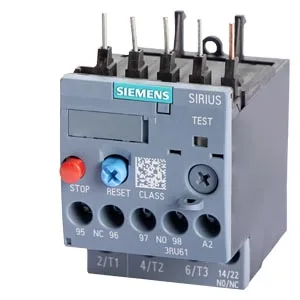
The Siemens 3RU6116-4AB0 is a SIRIUS thermal overload relay sized for motor protection in the S00 frame, adjustable from 11 to 16 A and rated Trip Class 10. Same part, different passport — this is current-production Siemens, not a legacy or obsolete line.
The 3RU6116-4AB0 is a contactor-mounted overload relay, meaning it clips directly onto the output side of a Siemens S00 contactor (e.g., 3RT1015, 3RT1016, 3RT1017 frames). No DIN rail required for the relay itself — it rides on the contactor. Panel integration is straightforward: the assembly occupies the contactor's footprint plus 6 mm clearance to grounded parts at the side. Mounting position is any, which helps in tight enclosures. The 45 mm width and 76 mm height match the S00 contactor profile; depth is 70 mm including the contactor interface.
Trip class and adjustment range
The adjustable current response range of 11 to 16 A covers common motor sizes like 5.5 kW at 400 V or 7.5 kW at 230 V. Set it via the dial on the front; no separate heater packs needed. The thermal design means it tracks the motor's actual heating curve, not just peak current, so nuisance tripping on short overloads is minimized.
Relative humidity tolerance is 0 to 90 %. The relay withstands 6 kV surge voltage and 8g shock at 11 ms per IEC 60068-2-27. Compliance documentation includes RoHS substance prohibitance dated May 1, 2012, covering the usual restricted materials. Installation altitude is limited to 2000 m above sea level; above that, derating applies.