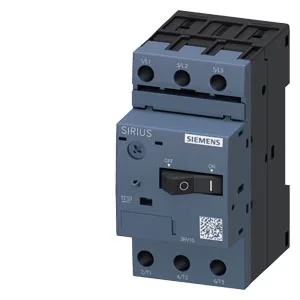
The 45 mm width occupies one 45 mm module slot; depth is 81 mm, height 90 mm. Spring-loaded terminals on the main current circuit accept 2x (0.25... 2.5 mm²) solid or 2x (0.25... 1.5 mm²) finely stranded with ferrule. No clearance needed at the side or rear, so it fits tight enclosures. IP20 on the front — protected against finger contact, not washdown.
Rated continuous current 0.25 A — this breaker is sized for very small motor loads, fractional-horsepower pumps, fans, or small conveyors. The CLASS 10 trip class means it will hold during a normal motor start (typically 6–10 seconds of inrush) but trip fast on a sustained overload. Breaking capacity is 100 kA at 240 V, 400 V, 500 V, and 690 V AC — that is a high-interrupting rating for a 0.25 A device, so it can be used in panels with high available fault current without needing a current-limiting fuse upstream. Mechanical endurance is 100 000 cycles — rated for frequent switching applications. Power dissipation is 5.5 W total, 1.8 W per pole — factor into enclosure thermal calculations.
Duty ratings and operating conditions
Maximum operating frequency at AC-3 duty is 15 operations per hour — sufficient for motor starting cycles but not for rapid jogging. Shock resistance is 25 g for 11 ms — suitable for mobile equipment or panels near rotating machinery.