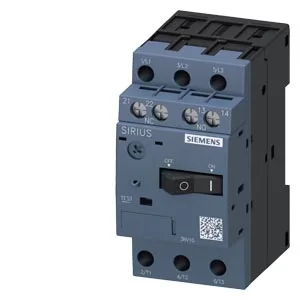
Its continuous current rated value of 0.32 A and CLASS 10 trip class mean it trips fast enough to protect a small motor winding before it overheats on a stalled rotor — CLASS 10 clears within 10 seconds at 7.2× rated current, which is the standard for standard-duty induction motors. Rated breaking capacity hits 100 kA at 240 V, 400 V, 500 V, and 690 V AC — that is a high-fault rating for a device this size, so it can be used downstream of a transformer or in a high-capacity distribution panel without needing a current-limiting fuse upstream.
Width is 45 mm, height 90 mm, depth 81 mm, so it occupies a single modular slot. Mounting position is any, which helps in tight enclosures where rail orientation varies. Main current circuit connections are screw-type terminals; solid and stranded conductors accepted: 2x (0.5... 1.5 mm²) and 2x (0.75... 2.5 mm²).
Auxiliary switch and ratings
Includes an auxiliary switch with transverse design, rated at 1 A at 24 V, 0.5 A at 230 V, and 0.15 A at 60 V — these are the switching capacities for the signal contact, not the main power path. The auxiliary switch lets a PLC or safety relay read the breaker's tripped state without running motor voltage back to the controller. Mechanical endurance of the main contacts is 100,000 operations typical. Shock resistance rated at 25g for 11 ms, which covers most industrial vibration environments without nuisance trips.