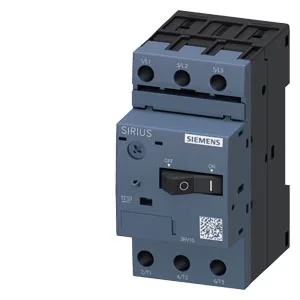
This Siemens SIRIUS 3RV1011-0DA20-ZX95 is a three-pole motor protection circuit breaker rated at a continuous current of 0.32 A, designed to protect a 0.09 kW motor at 400 V AC. It is a current-production part (lifecycle stage: current). The 100 kA breaking capacity holds at 240 V, 400 V, 500 V, and 690 V AC — meaning it can interrupt a bolted fault at any of those voltages without upstream fuses needing to clear first. That keeps the coordination simple in a panel with a 100 kA SCCR bus.
Trip Class and Motor Starting
Ground fault detection is not included — that stays external.
Mounting position is any, which helps when panel layout forces a horizontal or inverted orientation. Solid wire range is 2x (0.25 to 2.5 mm²); finely stranded with ferrule is 2x (0.25 to 1.5 mm²). Finger-safe touch protection is built into the front IP20 face — safe for live panel access with the cover on.
Thermal and Environmental Limits
Shock resistance is 25 g for 11 ms, typical for industrial panel mounting on a machine frame. The operating frequency at AC-3 duty is 15 operations per hour maximum — not a high-cycling application; for frequent starts, look at a contactor with a higher rated operating frequency.