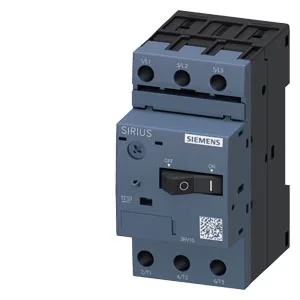
What it is and what it does
The Siemens SIRIUS 3RV1011-0EA10-ZX95 is a motor protection circuit breaker designed to protect three-phase induction motors against overload, short-circuit, and phase failure. It trips in Class 10, meaning it disconnects within 10 seconds at a locked-rotor current — fast enough to protect standard IEC motors during start-up without nuisance tripping. Phase failure detection is built in, so a lost phase on the line side will trip the breaker rather than letting the motor single-phase and overheat. Mounting is screw or snap-on onto 35 mm DIN rail per DIN EN 60715, and the mounting position is any — no derating for horizontal or vertical orientation. The 45 mm width matches the standard SIRIUS 3RV10 compact footprint, so it slots into a panel alongside contactors and overload relays without extra spacing.
Key ratings and what they mean for fit
The breaker carries a 100 kA breaking capacity at 400 V AC — that is the maximum fault current it can safely interrupt at that voltage. In a panel with a transformer or mains supply capable of delivering 100 kA, this breaker clears the fault without needing an upstream current-limiting fuse, provided the SCCR of the whole assembly is coordinated. At 240 V AC the same 100 kA rating holds. The motor power rating at 230 V is 0.1 kW, and the rated current at 480 V is 0.4 A — this is a small-frame breaker for fractional-horsepower motors, pumps, or fans. The trip class is fixed at Class 10, so it is suited for motors with short acceleration times; for high-inertia loads that need a longer start curve, a Class 20 or 30 device would be the correct choice.
Panel integration notes
The breaker measures 45 mm wide, 90 mm high, and 75 mm deep. Clearance requirements: 20 mm upwards, 20 mm downwards, 9 mm at the side, and 0 mm forwards and backwards — so it can be mounted flush against a backplate or enclosure wall without extra air gap. The screw-type terminals accept 2x (0.5 to 1.5 mm²) solid or stranded, or 2x (0.75 to 2.5 mm²). Storage temperature range is -50 to +80 °C; operating ambient is -20 to +60 °C.