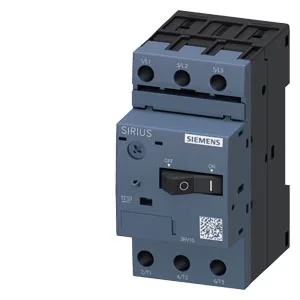
What it is and what it does
The Siemens SIRIUS 3RV1011-0FA10-ZW96 is a motor protection circuit breaker designed to protect three-phase induction motors against overload, short-circuit, and phase failure. It is part of the SIRIUS family, a modular system of industrial controls that share a common DIN-rail mounting and accessory platform. Rated for CLASS 10 trip characteristics, it disconnects the motor within 10 seconds at 7.2× the thermal setting — the standard for standard-start induction motors driving pumps, fans, and conveyors. The 100 kA breaking capacity at 400 V AC means it can safely interrupt a fault current up to that level without upstream fuses needing to clear first, which simplifies panel coordination. Phase failure detection is built in — if one phase drops out, the breaker trips before the motor single-phases and burns. No ground-fault detection on this variant, so if that's needed, you'd add a separate module or specify the G version.
Mounting and panel fit
Mounts via screw or snap-on onto 35 mm DIN rail per DIN EN 60715. The 45 mm width is a standard 2.5 module pitch — fits alongside SIRIUS contactors and overload relays in a common rail layout. Depth is 75 mm, height 90 mm. Clearance requirements: 20 mm upwards, 20 mm downwards, 9 mm to the side, zero forwards or backwards. That 9 mm side gap is tight — adjacent breakers can sit nearly flush. Screw-type terminals on the main circuit accept 2× (0.5…1.5 mm²) or 2× (0.75…2.5 mm²) solid or stranded copper. Torque to M3 screw spec. Mounting position is any, so vertical or horizontal rail orientation works.
Breaking capacity and coordination
Rated breaking capacity is 100 kA at 240 V, 400 V, 500 V, and 690 V AC. At 690 V, the spec calls for a gL/gG 4 A backup fuse to limit let-through energy — without it, the breaker may not clear a bolted fault at that voltage. At 240 V, 400 V, and 500 V, no upstream fuse is required. This makes it suitable for high-fault panels common in industrial distribution.
