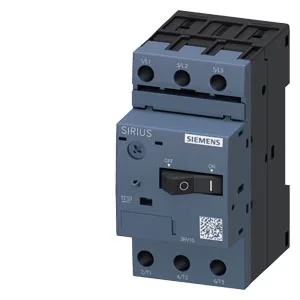
Rated at 0.1 kW at 230 V, this breaker is sized for fractional-horsepower motors — think small pumps, fans, or conveyor drives on a 230 V single-phase or three-phase line. The 100 kA breaking capacity at 400 V (and at 240 V, 500 V, and 690 V) means it safely interrupts fault currents up to that level without cascading upstream, which is critical for high-fault-capacity industrial panels where the available short-circuit current can exceed 50 kA.
That is the standard DIN rail found in every industrial control panel — no adapter plates needed. Dimensions are 45 mm wide, 90 mm high, 75 mm deep, so it occupies a single 45 mm slot on the rail, leaving room for adjacent contactors or overload relays. Clearance distances are specified: 20 mm upwards, 20 mm downwards, 9 mm to the side, 0 mm forwards and backwards. The forwards/backwards zero clearance means it can be panel-mounted flush against a backplate or enclosure wall without extra air gap, which simplifies panel layout in tight enclosures. Screw-type terminals for the main current circuit accept 2x (0.5 to 1.5 mm²) or 2x (0.75 to 2.5 mm²) solid or stranded wire, terminated with M3 screws. Strip length and torque values follow standard Siemens practice — typical for panel wiremen familiar with SIRIUS gear.
Rated operational voltage spans 20 to 690 V, covering low-voltage motor circuits from control transformers up to 690 V industrial mains.
Given its current lifecycle status and broad industrial installed base, supply is generally reliable for both new builds and MRO replacements.