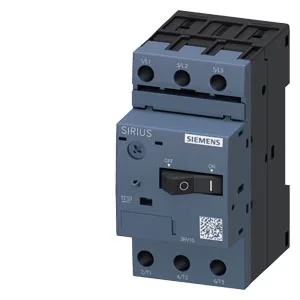
SIRIUS 3RV1011-0FA20-ZW95 — motor-protective circuit breaker, 0.5 A, CLASS 10
The Siemens 3RV1011-0FA20-ZW95 is a SIRIUS motor-protective circuit breaker rated for 0.5 A continuous current with a CLASS 10 trip characteristic, designed to protect 0.12 kW motors at 400 V AC. The CLASS 10 trip class ensures the breaker disconnects within 10 seconds under locked-rotor conditions, matching the thermal withstand of standard IEC induction motors up to the rated 0.12 kW.
Mounts via screw or snap-on onto 35 mm DIN rail per DIN EN 50022, occupying 45 mm width — a standard 2.5-module footprint for the panel layout. Main circuit uses spring-loaded terminals accepting 2x (0.25... 2.5 mm²) solid or 2x (0.25... 1.5 mm²) finely stranded with ferrule. IP20 on the front face means finger-safe from the panel front; the rear and sides are protected by the enclosure. Any mounting position is allowed, and the 81 mm depth fits standard shallow enclosures.
The auxiliary switch is present (Yes), but no auxiliary contacts are included (0) — the switch is a built-in signal contact for remote status indication, not a separate add-on block. Power dissipation is 5.5 W total in hot operating state (1.8 W per pole) — factor this into enclosure thermal calculations when grouping multiple breakers. Mechanical endurance of 100,000 typical cycles and shock resistance of 25g / 11 ms suit it for high-vibration applications. Maximum operating altitude 2,000 m — above that, derate the continuous current and breaking capacity per IEC 60947-2 guidelines.