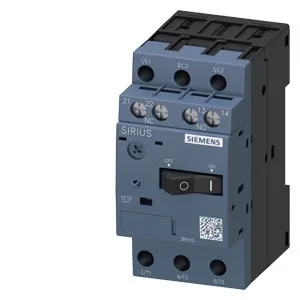
It screws or snaps onto the rail — no tools needed for snap-on, but the screw mount gives you a solid hold in high-vibration panels. The Note 1 on this line flags something worth knowing: the auxiliary contacts (24 V at 1 A, 60 V at 0.15 A, 110–125 V at 2 A, 230 V at 0.5 A) need their own fuse protection above certain voltages — at 500 V and 690 V they require a gL/gG 6 A fuse in series. That's not a gotcha if you read the nameplate, but it'll bite you if you assume the breaker's internal contacts are self-protected at all voltages.
That's the standard for standard-duty motor starting (pumps, fans, compressors) where the start-up transient clears before the breaker nuisance-trips. The rated switching frequency of 15 operations per hour at AC-3 and AC-3e duty means it's built for occasional start-stop cycles, not a jogging or reversing application that cycles every minute. That's a high-fault rating for a 45 mm-wide breaker — it handles downstream short-circuits up to 100 kA without the upstream device needing to clear the fault. In a panel with a transformer feeding a 400 V bus, that buys you selectivity headroom. At 240 V it's also 100 kA. Motor power rating at 230 V is 0.1 kW. That's a small motor — fractional horsepower — so this breaker is for the little guys: a cooling fan, a small pump, an actuator drive. The rated value range of 20 to 690 V covers most industrial control voltages worldwide.
Mounting position is any — vertical, horizontal, upside-down, doesn't matter for the thermal-magnetic trip. Clearance requirements: 20 mm upwards, 20 mm downwards, 9 mm at the side. That 9 mm side gap is tight enough to pack breakers side-by-side in a multi-motor panel. The terminals accept 2× (0.5 to 1.5 mm²) or 2× (0.75 to 2.5 mm²) solid or stranded copper — M3 screws for the main contacts. That -20 °C low end is fine for unheated enclosures in temperate climates, but if your panel sits outdoors in a -40 °C winter, you need a different breaker or a heater.