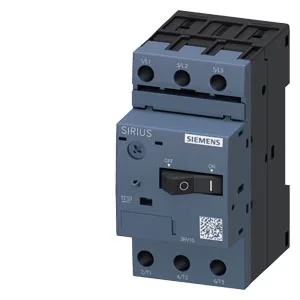
It combines a thermal overload relay and a magnetic short-circuit release in one 45 mm wide package, sized for a 0.63 A continuous current rating and a Trip Class 10 release curve — meaning it will trip within 10 seconds at 7.2× rated current, which is the standard for protecting standard induction motors against locked-rotor conditions without nuisance tripping on startup. Rated breaking capacity sits at 100 kA across all common AC voltages — 240 V, 400 V, 500 V, and 690 V — so it can interrupt a fault up to that level without upstream fuses needing to clear first, as long as the prospective short-circuit current at the installation point doesn't exceed that figure.
Mounting and wiring — no surprises on the rail
Main circuit and auxiliary/control circuit both terminate through spring-loaded terminals. Accepts solid conductors 2x (0.25...2.5 mm²) or finely stranded with ferrule 2x (0.25...1.5 mm²). AWG range for main contacts is 2x (24...14). No screwdriver needed — strip, push, done. IP20 finger-safe front means the terminals are touch-protected when the breaker is mounted in an enclosure. The unit has zero backward clearance and zero side clearance required — can butt it against adjacent devices on the rail without derating.
Key protections and ratings at a glance
No ground fault detection on this variant. Rated insulation voltage is 690 V, surge voltage resistance 6000 V, and power dissipation at rated current in hot operating state is 5.5 W total (1.8 W per pole). Shock resistance is rated at 25g for 11 ms. RoHS compliance date is marked as 01.01.2013 — the part meets the EU RoHS directive effective from that date. Auxiliary switch extension is supported (product extension auxiliary switch = Yes), so you can add a signal contact for remote status indication without modifying the breaker itself.