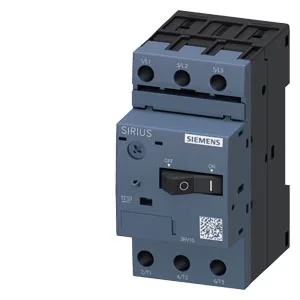
Motor protection circuit breaker for the panel builder
The unit is rated 0.1 kW at 230 V and 0.8 A at 480 V and 600 V, so it's sized for small motor loads like pumps, fans, or conveyors in a control panel. No ground fault detection on this variant, so if that's needed, you'd step up to a different order code in the family.
Clearance requirements: 20 mm upwards, 20 mm downwards, 9 mm at the side, 0 mm forwards and backwards. Screw-type terminals for the main current circuit, accepting 2x (0.5 to 1.5 mm²) or 2x (0.75 to 2.5 mm²) solid or stranded wire. Terminal screws are M3. No special tools beyond a standard screwdriver.
The -ZW95 suffix indicates a special version. The base order code 3RV1011-0HA10 is the standard variant; functionally they share the same ratings and footprint.
Backup fuse and environmental limits
At 240 V and 400 V, no backup fuse is needed — the breaker's own 100 kA SCCR handles it. Maximum switching frequency at AC-3 duty is 15 operations per hour — fine for occasional motor starts, not for high-cycling applications like rapid reversing.