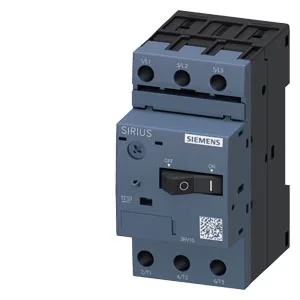
What this SIRIUS breaker does on the line
There is no ground fault detection on this variant, so for applications requiring GF protection, you would add an external ground-fault relay or choose a different SIRIUS version.
The breaker measures 45 mm wide by 90 mm high by 75 mm deep — a standard 45 mm module that fits directly onto 35 mm DIN rail per DIN EN 60715, using either screw fixing or snap-on mounting. Clearance requirements are minimal: 20 mm upwards, 20 mm downwards, 9 mm to the side, and 0 mm forwards or backwards. That means it fits tightly into a crowded enclosure without extra breathing space. Terminals are M3 screw-type for the main current circuit, accepting 2 × (0.5 to 1.5 mm²) or 2 × (0.75 to 2.5 mm²) solid or stranded wire.
Fuse coordination and switching frequency
At 240 V and 400 V, no upstream fuse is required — the breaker's own breaking capacity handles the fault. Maximum switching frequency is 15 operations per hour under AC-3 and AC-3e duty, which is typical for motor-starting applications — not for frequent jogging or inching cycles.