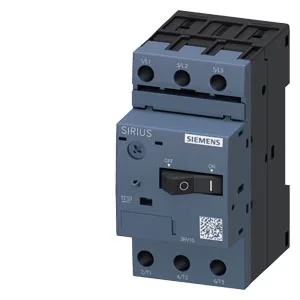
It's the 1 A continuous current variant with a CLASS 10 trip characteristic, meaning it will trip fast enough to protect a standard induction motor during a stall or locked-rotor condition — the CLASS 10 curve clears within 10 seconds at 7.2× the thermal setting. Rated 0.25 kW at 400 V, it's sized for small motor loads like fans, pumps, or small conveyors. The breaking capacity is a flat 100 kA across the board — at 240 V, 400 V, 500 V, and 690 V AC. That's a high-interrupting rating for a 45 mm wide device; it handles fault currents up to 100 kA without needing an upstream fuse or backup breaker, which simplifies panel design and saves a fuse holder.
Any mounting position works, which helps in cramped enclosures. Terminals are screw-type for the main circuit, accepting solid or stranded conductors: 2× (0.5…1.5 mm²) or 2× (0.75…2.5 mm²). AWG equivalents are 2× (18…14). No auxiliary contacts are included (0 for auxiliary contacts), but an auxiliary switch can be added — the frame accepts the standard SIRIUS aux block. IP20 on the front, so it's protected against finger contact in the panel.
Environmental and electrical endurance
Rated for -20 to +60 °C operating ambient, with storage and transport range from -50 to +80 °C. Altitude rated to 2 000 m without derating. Shock resistance is 25g for 11 ms — survives typical panel vibration and handling during transport. Mechanical life of the main contacts is 100 000 operations typical at AC-3 duty. No ground fault detection on this variant, so pair with a ground-fault relay if that's required. Surge voltage resistance is rated at 6 000 V, and the maximum switching frequency at AC-3 is 15 operations per hour.