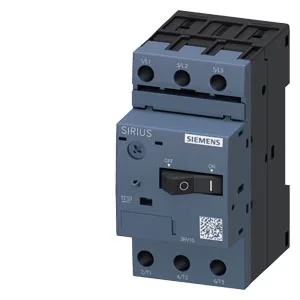
The 3RV1011-1AA10-ZW95: Breaking capacity is 100 kA at 240 V, 400 V, and 500 V. No ground fault detection. If your motor circuit needs ground fault protection, you'll need a separate GF relay or a different breaker variant. Switching frequency is rated at 15 operations per hour for AC-3 and AC-3e duty. That's one start every four minutes — fine for a conveyor or pump, but not for a jogging or rapid-cycling application like a stamping press or a reversing table. Motor horsepower ratings: 0.1 hp at 230 V, 1 hp at 460/480 V, 0.8 hp at 575/600 V. Current ratings at 480 V and 600 V are 1.6 A. These are the values you'd use for sizing on a motor nameplate. Voltage range is 20 to 690 V. That's the operating voltage range for the main circuit, not the coil — this is a thermal-magnetic breaker, not a contactor, so there's no coil to worry about.
Width is 45 mm, depth 75 mm, height 90 mm. That 45 mm width is one standard module — it takes up a single slot on a DIN rail, so you can plan your panel layout accordingly. Clearance requirements: 20 mm upwards and downwards, 9 mm at the side, 0 mm forwards and backwards. The zero forward/backward clearance means it can be mounted flush against a panel backplate or enclosure wall. The 20 mm vertical clearance is needed for arc venting and heat dissipation. Mounting position is any. You can install it sideways or upside-down without derating — useful when you're cramming components into a tight enclosure. Accepts 2x (0.5 to 1.5 mm²) or 2x (0.75 to 2.5 mm²) solid or stranded wire. The M3 terminal screws are standard for this class.
Temperature range and backup fuse requirements
Operating temperature is -20 to +60 °C. If the breaker will sit in a hot warehouse or a non-climate-controlled panel, the storage range is generous enough. Backup fuse requirements: at 240 V, none required. The 240 V condition is self-protecting; above that, the 20 A fuse backs up the breaker for fault currents above its interrupting capacity.