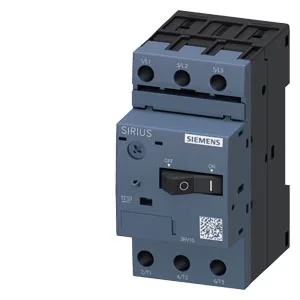
The 45 mm width and 75 mm depth keep it compact for dense MCC or control-panel rows. Trip Class 10 means it clears an overload within 10 seconds at 7.2× rated current — standard for general-purpose motor starting where the inrush doesn't exceed that window. No ground-fault detection on this variant; that's a separate function if your circuit demands it.
Interrupting capacity and coordination
Rated interrupting capacity hits 100 kA at 240 V, 400 V, and 500 V — that's high enough for most industrial service-entrance or sub-distribution panels without needing a current-limiting upstream breaker. At 690 V it drops to 2 kA, so on 690 V systems verify the available fault current stays below that threshold or add a backup fuse. The manufacturer specifies backup fuse requirements: at 400 V use a gL/gG 20 A fuse; at 500 V the same; at 690 V also gL/gG 20 A. At 240 V no backup fuse is required. The 100 kA rating at 400 V means this breaker can safely interrupt a fault up to that level without cascading upstream — a key spec for panel builders coordinating selectivity in a UL 508A or IEC 61439 assembly.
Termination and environmental limits
Main circuit terminals are screw-type, accepting 2× (0.5 to 1.5 mm²) or 2× (0.75 to 2.5 mm²) solid or stranded copper. Torque spec for the M3 main-contact screws is standard — no special tooling needed. Operating temperature range is -20 to +60 °C; storage and transport range is -50 to +80 °C, so it handles warehouse and trucking extremes without issue. Clearance spacing: 20 mm upwards and downwards, 9 mm at the sides, 0 mm forwards and backwards. That's tight enough to pack breakers side-by-side in a multi-row panel without excessive gutters.