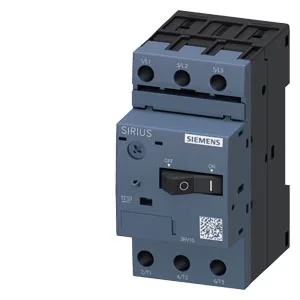
What it is and what it does in a panel
The Siemens 3RV1011-1GA10-ZX95 is a SIRIUS motor protection circuit breaker, designed to protect motor branch circuits against overload, short-circuit, and phase failure. It snaps onto a 35 mm DIN rail per DIN EN 60715 and terminates with screw-type terminals accepting 2x (0.5 to 2.5 mm²) solid or stranded conductors. Trip Class 10 means it clears an overload within 10 seconds at 7.2× rated current — fast enough to protect standard induction motors during stalled-rotor or jam conditions without nuisance tripping on normal starting inrush. Phase failure detection is built in, so a lost leg on the supply side trips the breaker before single-phasing cooks the winding. Short-circuit breaking capacity hits 100 kA at both 240 V and 400 V, which puts it well into the high-fault-current territory common in industrial MCCs and distribution panels downstream of large transformers. At 690 V it still holds 2 kA — that covers most 600 V class motor circuits in North American and European installations.
Panel footprint and clearances
The breaker body measures 45 mm wide × 90 mm tall × 75 mm deep — a standard 45 mm module width that lines up with other SIRIUS components on the same DIN rail. No side clearance needed between units; 20 mm above and below for wiring access, zero forward or backward clearance required from the mounting surface. Mounting position is any orientation, which simplifies layout in tight enclosures or when the rail is vertical. The screw-and-snap-on fastening lets you pre-assemble the rail outside the panel and clip the breaker on as a group.
Selectivity and coordination notes
For selective coordination upstream of a motor starter, the required backup fuse depends on the prospective fault voltage: at 400 V use a gL/gG 50 A fuse; at 500 V or 690 V step down to gL/gG 40 A. At 240 V no upstream fuse is required — the breaker's 100 kA SCCR stands alone.
