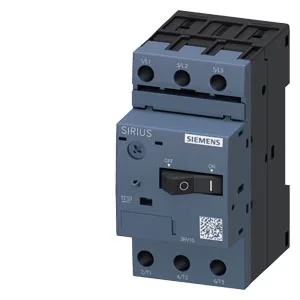
The Siemens SIRIUS 3RV1011-1HA10-ZW97 is a motor protection circuit breaker — a combined thermal-magnetic device sized for a 45 mm DIN-rail footprint (width 45 mm, depth 75 mm, height 90 mm) that snaps onto 35 mm rail per DIN EN 60715 using the screw and snap-on method. It is designed for motor protection, meaning the thermal element tracks motor heating while the magnetic element handles short-circuits. No ground fault detection on this variant.
The interrupting ratings are given at multiple voltages because the arc energy changes with system voltage. At 240 V this breaker can interrupt 100 kA — that is a very high fault current, typical for a transformer-fed panelboard. At 400 V it drops to 13 kA, at 500 V to 3 kA, and at 690 V to 2 kA. The gL/gG fuse backup ratings (80 A at 240 V, 63 A at 400 V, 40 A at 500 V and 690 V) tell you the maximum upstream fuse that still lets the breaker coordinate — if the fault exceeds the breaker's own interrupting rating, the fuse clears it instead. For a 400 V motor branch, 13 kA SCCR is adequate for most industrial panels unless you are near a large transformer. The rated voltage range spans 20 to 690 V, so it works on 208–600 V systems common in North America and 400–690 V in Europe.
Mounting and clearances — what the panel builder needs
The required clearances are specific: 20 mm upwards, 20 mm downwards, 9 mm at the side, 0 mm forwards, 0 mm backwards. Zero forward clearance means the breaker can sit flush against a gland plate or door — no extra breathing space needed in front. The 9 mm side clearance is tight; adjacent breakers can be packed close. The screw-type terminals accept 2×(0.5…1.5 mm²) solid or stranded, or 2×(0.75…2.5 mm²), with M3 screws on the main contacts.