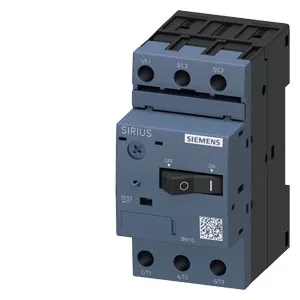
The overload release is thermal (bimetal), the short-circuit trip is magnetic — the standard combo for motor branch-circuit protection. No ground-fault detection on this variant. Wire range accepts 2x (0.5 to 1.5 mm²) solid or stranded, or 2x (0.75 to 2.5 mm²) — covers most motor feeder sizes up to 2.5 mm². AWG equivalent is 2x (18 to 14). Mounting position is any orientation. Zero clearance needed at the sides or back for heat dissipation, which simplifies panel layout.
This breaker's interrupting rating varies sharply with voltage: 100 kA at 240 V AC, 50 kA at 400 V AC, dropping to 3 kA at 500 V and 2 kA at 690 V. At 690 V the 2 kA rating is low; if your panel sees high fault current at that voltage, this isn't the right breaker. Rated impulse withstand voltage is 6 kV, which covers typical surge environments in industrial control panels.
RoHS compliance date is 01/01/2013, meaning it meets the EU substance restrictions that took effect that year. No UL or CSA listing is stated in the evidence, but the part carries the Siemens SIRIUS brand and is designed to IEC/EN 60947 standards common in European-sourced panels.
Panel integration
Width is 45 mm — three 15 mm modules on a DIN rail, standard for a 3-pole motor-protective device. Depth is 81 mm, height 90 mm. Power dissipation at rated current is 9.25 W total, 3.1 W per pole in hot operating state. That's moderate for a 10 A breaker — account for it in enclosure thermal calculations, especially if multiple units are ganged without spacing. An auxiliary switch can be added (product extension auxiliary switch is supported).