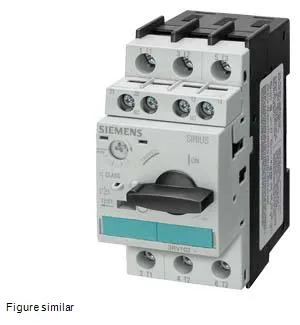
It's designed to protect motors against overload and short-circuit, with phase failure detection built in.
The 0.25 A continuous current rating is the setting you lock in for motor full-load current. At 400 V, this breaker covers motor power up to 0.06 kW. Breaking capacity holds at 100 kA across the voltage range from 240 V through 690 V AC. That's a uniform high-fault rating that simplifies panel design — you don't need to derate for higher supply voltages. The maximum switching frequency under AC-3 duty is 15 operations per hour, which suits motor starting cycles but not rapid jogging. Mechanical life of the main contacts is rated at 100 000 operations typical. Power dissipation in hot operating state is 5.5 W total, or 1.8 W per pole — negligible for panel thermal budgeting but worth noting if you're packing breakers tightly.
Wiring and integration
Main circuit terminals are screw-type, accepting solid or stranded conductors: 2x (1... 2.5 mm²) or 2x (2.5... 6 mm²). For AWG, that's 2x (14... 10). Finely stranded wire with ferrule is also supported in the same ranges. The auxiliary switch is present on this variant, but there are zero factory-fitted auxiliary contacts — the switch is integral to the breaker mechanism. Shock resistance is 25g for 11 ms, and mounting position is any orientation.