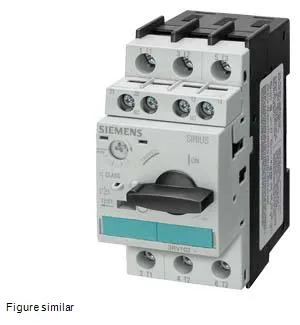
Motor protection circuit breaker, 0.32 A, CLASS 10 — SIRIUS 3RV1021
Rated breaking capacity hits 100 kA at 400 V AC (also 100 kA at 240 V, 500 V, and 690 V), so it can be installed upstream of a motor starter without needing a separate backup fuse in most industrial distribution panels — that 100 kA holds across the full voltage range. No ground fault detection on this variant — that's a separate accessory.
Screw-type terminals on the main circuit accept solid or stranded conductors: 2×(1…2.5 mm²) and 2×(2.5…6 mm²) per clamp. AWG equivalents are 2×(14…10). The auxiliary switch option is present, but this order code ships with zero factory-fitted auxiliary contacts — add them separately if you need status feedback. IP20 finger-safe protection on the front; the rear and sides are open to the panel environment. Mounting position is unrestricted, and zero clearance is required at the sides or rear — it can sit flush against the panel wall or adjacent devices.
The 0.32 A continuous rating paired with CLASS 10 trip fits small motors in the 0.09 kW range at 400 V — think fractional-horsepower pumps, fans, or conveyor drives. In a dense MCC column with multiple breakers, that heat adds up — account for it in the enclosure thermal calculation. Mechanical endurance is 100,000 operating cycles typical for the main contacts.