What it is and what it does
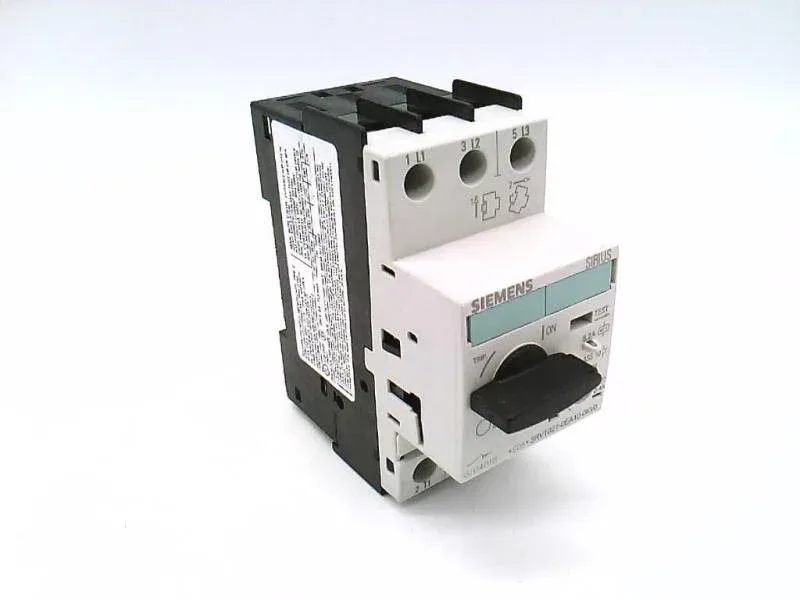
The Siemens 3RV1021-0EA10-0FJ0 is a SIRIUS motor protection circuit breaker rated for 0.4 A continuous current with a CLASS 10 trip curve, meaning it will clear a locked-rotor condition fast enough to protect a standard induction motor during start-up without nuisance tripping on the inrush. It breaks 100 kA at 400 V AC — that's the full rated short-circuit capacity at that voltage, so it can sit upstream of a motor starter without needing a separate fuse or backup breaker for fault currents up to that level. Phase failure detection is built in, so if one leg drops out the breaker trips — a common failure mode on three-phase motor circuits that otherwise cooks the winding. No ground-fault detection on this variant, so if you need that, look at the GF versions in the same family.
Mounting and panel fit
Mounts on 35 mm DIN rail per DIN EN 50022 with either screw-fix or snap-on — the snap-on lets you pop it on and off without tools, which is handy when you're swapping a failed unit in a crowded panel. Width is 45 mm, depth 96 mm, height 97 mm. Backwards clearance is 0 mm and side clearance is 0 mm, so it can butt directly against other devices on the rail — no air gap needed for cooling or arc containment. That's a space saver in tight enclosures. Mounting position is any, which helps when the panel layout forces a horizontal or inverted orientation — no derating for angle.
Termination and wiring
Main circuit terminals are screw-type, accepting solid or stranded conductors: 2x 1…2.5 mm² and 2x 2.5…6 mm². For AWG, that's 2x 14…10. Finely stranded with ferrule is the same range. The auxiliary switch is present — it's integrated, so you don't need a separate side-mount block for status feedback. No additional auxiliary contacts are included, but the built-in switch covers the basic NO/NC for the control circuit.
Environmental and mechanical limits
Operating temperature range is -20 to +60 °C; storage and transport handle -50 to +80 °C. Shock resistance is 25 g for 11 ms — tough enough for machinery-mounted panels. Altitude limit is 2 000 m without derating; above that you'll need to account for reduced air density on arc extinction. Front face is IP20 — finger-safe but not sealed; install inside a cabinet rated for the environment.
