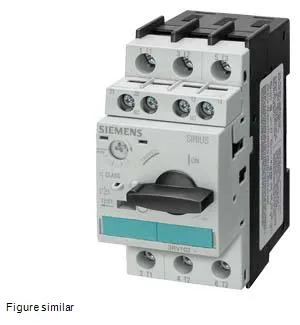
Motor protection breaker, 0.63 A, CLASS 10 — panel fit and interrupting duty
The Siemens 3RV1021-0GA15-ZX95 is a SIRIUS motor protection circuit breaker sized for a 0.63 A continuous rated current and a 0.18 kW motor at 400 V AC, with a CLASS 10 trip characteristic — meaning it will clear a stalled-rotor condition fast enough to keep the motor winding below its thermal limit, provided the upstream short-circuit protection coordinates. The interrupting rating holds at 100 kA across the 240 V to 690 V AC range, so this breaker can be placed downstream of a high-capacity transformer without requiring a current-limiting upstream device — a real advantage when the panel SCCR needs to stay above 65 kA.
Mounting and wiring — DIN rail footprint and terminal capacity
The breaker snaps onto a 35 mm DIN rail per DIN EN 50022 and occupies a 45 mm width, 97 mm height, 96 mm depth footprint — a standard SIRIUS frame that leaves 0 mm clearance needed at the back or sides, so it rows tightly with contactors in a motor starter cell. Screw-type terminals on the main circuit accept 2x (0.5 to 1.5 mm²) solid or 2x (1 to 2.5 mm²) stranded, with AWG equivalents of 2x (14 to 10) for the main contacts. The auxiliary and control circuit terminals use the same screw-type format, keeping the wire range consistent across the assembly. Front-side IP20 protection means the busbars and terminals are touch-safe once the cover is on, but the breaker is not sealed against washdown — keep it inside the enclosure, not on the machine frame.
Lifecycle and compliance — current production, RoHS dated
The 3RV1021-0GA15-ZX95 carries a lifecycle stage of current production, so it remains a standard catalog item for new panel builds and BOM-freeze projects — no last-time-buy clock is running. RoHS compliance is documented with a substance prohibition date of 01.05.2012, covering the EU directive scope. The storage and transport temperature range of -50 to +80 °C exceeds the operating range of -20 to +60 °C, which is typical for a component that must survive warehouse cold soak but run inside a ventilated enclosure.
Auxiliary switch provision and operating frequency
The breaker accepts a transverse-design auxiliary switch — useful for remote status indication or safety-circuit feedback without adding an external interposing relay. The maximum switching frequency under AC-3 duty is 15 operations per hour, which governs cycling applications like reversing starter or jogging stations.